
Hair fall and alopecia disorders represent a growing global concern, affecting both men and women across age groups. Lifestyle stressors, nutritional deficiencies, hormonal imbalances, inflammatory scalp conditions, and autoimmune disorders such as alopecia areata contribute significantly to progressive hair thinning and loss. Amid increasing interest in evidence-based natural interventions, onion juice particularly red onion juice has emerged as a scientifically investigated, low-cost, phytotherapeutic option for improving hair growth and scalp health.
Unlike anecdotal remedies, onion juice has been evaluated in controlled clinical settings, with mechanistic insights rooted in its rich sulfur compounds, flavonoids, and antioxidant profile. This article critically examines why red onion is superior, its biochemical mechanisms, and its clinical relevance in hair fall and alopecia areata, supported by published scientific evidence.
What Is Onion (Allium cepa) and Why Is It Important for Hair Growth?
Onion (Allium cepa L.) is a widely consumed bulb vegetable belonging to the Amaryllidaceae family, long recognized for its medicinal properties in traditional systems such as Ayurveda, Unani, and Traditional Persian Medicine. Modern phytochemical analysis confirms that onion is a functional food rich in bioactive compounds with dermatological relevance.
Onion juice is particularly important for hair growth due to its ability to influence multiple biological pathways involved in the hair cycle namely the anagen (growth), catagen (regression), and telogen (resting) phases. Hair loss often results from premature transition from anagen to telogen, follicular inflammation, oxidative stress, or immune-mediated follicular damage.
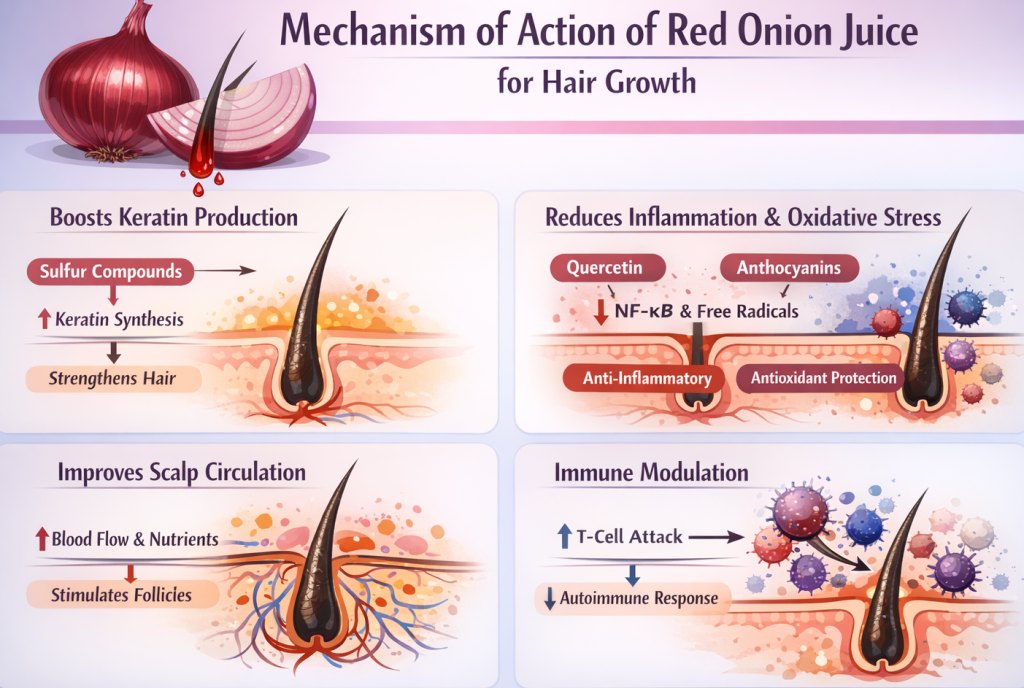
Red onion juice addresses these mechanisms by:
- Enhancing keratin synthesis
- Improving scalp microcirculation
- Reducing oxidative and inflammatory damage
- Supporting immune modulation at the follicular level
Types of Onion and Their Phytochemical Differences
Onions are broadly classified into red, white, and yellow varieties, each differing in pigment, sulfur content, and flavonoid concentration.
Yellow onions contain moderate levels of sulfur compounds and quercetin, while white onions are comparatively lower in antioxidant density. Red onions, however, are uniquely enriched with anthocyanins and higher total polyphenol content, which impart their deep purple-red coloration.
According to Slimestad et al., Journal of Agricultural and Food Chemistry (2007), red onions contain significantly higher quercetin glycosides and anthocyanins than other varieties, contributing to superior antioxidant and anti-inflammatory activity.
These biochemical distinctions make red onion the preferred choice for therapeutic scalp and hair applications.
Why Red Onion Is Superior for Preventing Hair Fall
Red onion juice contains a synergistic matrix of bioactive compounds, including:
- Organosulfur compounds (cysteine sulfoxides, thiosulfinates)
- Quercetin and quercetin glycosides
- Anthocyanins
- Saponins
- Trace minerals such as sulfur, zinc, selenium, and iron
These constituents directly influence hair follicle biology.
Table 1. Clinical Benefits of Red Onion Juice Mapped to Hair Disorders
| Hair Condition | Clinical Benefit | Mechanistic Basis | Strength of Evidence |
| Alopecia areata | Hair regrowth | Immune suppression + follicle reactivation | High (RCT) |
| Telogen effluvium | Reduced shedding | Improved keratin strength | Moderate |
| Dandruff-associated hair fall | Scalp normalization | Antifungal activity | Moderate-High |
| Stress-related hair loss | Improved anagen phase | Antioxidant + circulation | Moderate |
| Dry/damaged hair | Improved texture | Sulfur cross-linking | Supportive |
How Red Onion Juice Works at the Cellular Leve
1. Sulfur-mediated keratin synthesis
Hair shafts are composed primarily of keratin, a sulfur-rich structural protein. Red onion provides bioavailable sulfur, enhancing disulfide bond formation within keratin fibers, improving hair strength and reducing breakage.
2. Quercetin-driven anti-inflammatory signaling
According to Boots et al., European Journal of Pharmacology (2008), quercetin inhibits NF-κB and COX-2 pathways, reducing scalp inflammation that disrupts follicular cycling.
3. Antioxidant protection of follicular stem cells
Anthocyanins scavenge reactive oxygen species (ROS), protecting dermal papilla cells, which are critical for hair regeneration.
4. Improved microcirculation
Topical onion juice induces mild vasodilation, improving oxygen and nutrient delivery to hair follicles, prolonging the anagen phase.
5. Stimulates Hair Growth
Hair growth stimulation occurs through reactivation of dormant follicles and prolongation of the anagen phase. Sharquie et al., Journal of Dermatology (2002), demonstrated that topical onion juice significantly increased hair regrowth in alopecia areata patients compared to placebo, suggesting follicular stimulation rather than cosmetic camouflage.
Sulfur compounds activate Wnt/β-catenin signaling, a critical pathway for follicular regeneration, while antioxidants preserve follicular stem cell niches.
6. Reduces Hair Fall
Hair fall is frequently associated with follicular miniaturization, inflammation, and protein degradation. Red onion juice mitigates these processes by strengthening the hair shaft, reducing scalp inflammation, and decreasing oxidative stress.
Regular application improves hair anchorage, reducing excessive telogen shedding often observed in chronic stress and nutritional hair loss.
7. Combats Dandruff and Scalp Infections
Onion juice exhibits broad-spectrum antimicrobial and antifungal activity. According to Griffiths et al., Journal of Antimicrobial Chemotherapy (2002), thiosulfinates inhibit growth of Malassezia species implicated in dandruff and seborrheic dermatitis.
By restoring scalp microbiome balance, red onion juice indirectly supports healthy hair growth.
Improves Hair Texture and Natural Shine
Repeated oxidative and environmental damage disrupts hair cuticle integrity. Onion juice improves cuticular cohesion and hydration, leading to smoother, shinier hair strands. Enhanced sulfur cross-linking improves elasticity and tensile strength.
Treats Dry and Damaged Hair
Red onion juice supports scalp hydration and lipid balance, improving sebum regulation and reducing transepidermal water loss. Its antioxidant profile protects against UV-induced hair protein degradation.
May Aid in Treating Alopecia Areata
Alopecia areata is an autoimmune condition characterized by T-cell-mediated follicular attack. Quercetin’s immunomodulatory properties help suppress Th1-driven inflammation, allowing follicles to re-enter the growth phase.
Sharquie et al., Journal of Dermatology (2002), reported that 86.9% of patients using onion juice experienced regrowth, compared to 13% in the control group, highlighting its therapeutic potential.
Table 2. Comparison of Onion Varieties for Hair Growth Applications
| Parameter | Red Onion | Yellow Onion | White Onion |
| Total flavonoids | Highest | Moderate | Low |
| Quercetin content | High | Moderate | Low |
| Anthocyanins | Present | Absent | Absent |
| Antioxidant capacity | Very high | Moderate | Low |
| Suitability for alopecia areata | Excellent | Limited | Poor |
| Preferred for topical use | Yes | Conditional | Not recommended |
Source: Slimestad R, Journal of Agricultural and Food Chemistry (2007)
How to Prepare Red Onion Juice at Home
Fresh red onions should be washed, peeled, and blended or grated. The pulp is then filtered through sterile muslin cloth to obtain juice. Fresh preparation preserves volatile sulfur compounds responsible for therapeutic effects.
How and When to Use Onion Juice for Maximum Hair Regrowth
Onion juice should be applied to the scalp using gentle massage, preferably in the evening to allow prolonged contact. Application two to three times weekly is optimal for follicular stimulation without excessive irritation.
How Long Should Onion Juice Be Kept on Hair?
Clinical protocols suggest a contact time of 30-60 minutes, after which the scalp should be rinsed with a mild, sulfate-free cleanser.
Who Should Try Onion Juice and Who Should Avoid It
Individuals with non-scarring alopecia, stress-related hair fall, dandruff-associated shedding, and early alopecia areata may benefit most. Those with contact dermatitis, hypersensitive scalp, or open scalp lesions should avoid use.
Table 3. Clinical Evidence Supporting Onion Juice for Hair Growth
| Journal | Study Design | Population | Intervention | Key Outcomes | Clinical Relevance |
| Journal of Dermatology | Randomized controlled trial | Patients with alopecia areata | Topical fresh onion juice | 86.9% showed hair regrowth vs 13% control | First clinical evidence supporting onion juice in autoimmune hair loss |
| Journal of Antimicrobial Chemotherapy | In vitro & mechanistic study | Pathogenic scalp microbes | Onion sulfur compounds | Inhibition of bacterial & fungal growth | Supports dandruff and infection-related hair fall management |
| European Journal of Pharmacology | Mechanistic cellular study | Inflammatory cell models | Quercetin (onion flavonoid) | NF-κB inhibition, ↓ inflammatory cytokines | Explains anti-inflammatory action in alopecia areata |
| Journal of Agricultural and Food Chemistry | Phytochemical analysis | Onion varieties | Red vs white/yellow onions | Red onion highest quercetin & anthocyanins | Justifies preference of red onion for therapeutic use |
Together, these studies provide clinical, biochemical, and mechanistic validation for onion juice as a supportive intervention in hair loss management.
Bottom Line
Red onion juice stands out as a scientifically supported, phytochemically rich natural intervention for hair fall and alopecia areata. Its superior sulfur content, potent antioxidants, and immunomodulatory flavonoids provide a multifactorial mechanism addressing the root causes of hair loss. While not a substitute for medical therapy in severe cases, red onion juice represents a cost-effective, evidence-based adjunct in holistic hair care strategies.
Disclaimer: This article is for educational purposes only and does not substitute professional medical advice. Consult a qualified healthcare provider for dietary guidance.
Written By: DRx. Shabina Khan (Clinical Pharmacist)
Approved By: Dr Prateek Sharma (PhD, Pharmacology)